 English
 Arabic
Is NVIDIA done just selling chips — and now going after the business of on-site integrators?
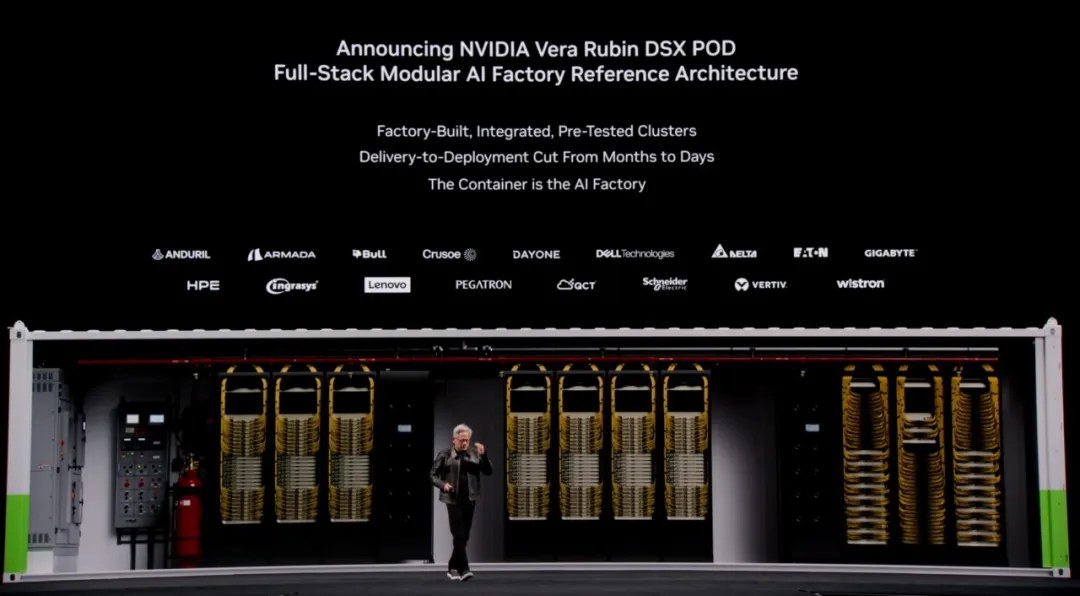
On October 21, Jensen Huang officially unveiled the DSX POD at GTC Berlin. It is an AI factory solution built inside modular containers on the Vera Rubin platform. According to NVIDIA, it can cut on-site deployment time to as fast as 14 days, with delivery planned for early 2027.
01
Out-of-the-Box: Compute, Networking, Power and Cooling Integrated
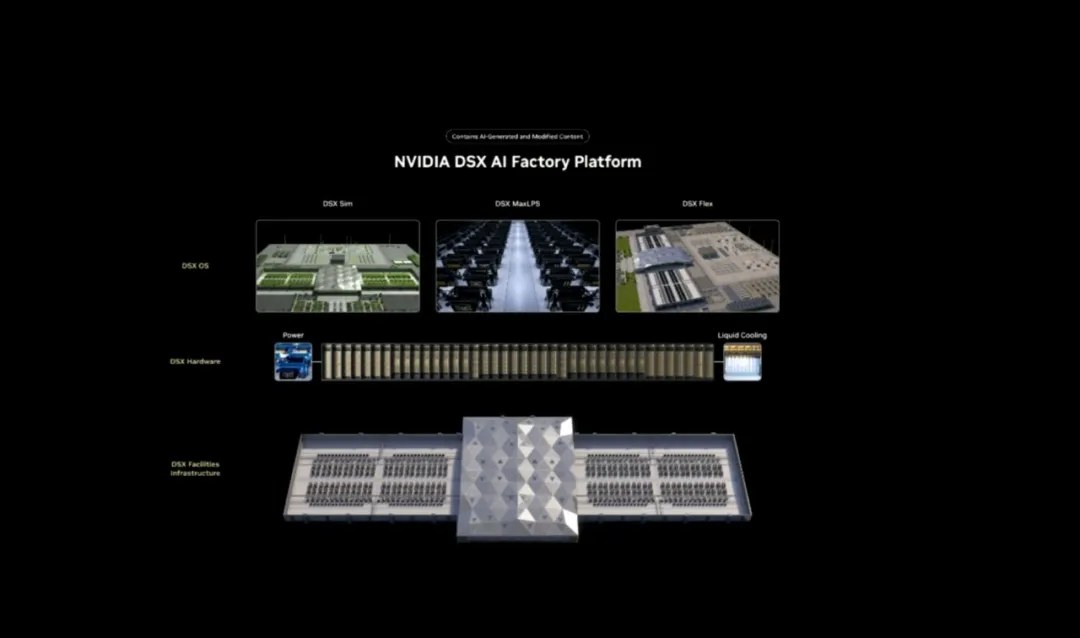
A single DSX POD integrates seven Vera Rubin NVL72 liquid-cooled racks — 504 Rubin GPUs and 252 Vera CPUs in total — connected by 17 km of Spectrum-X cables. The solution brings compute, networking, storage, power, liquid cooling and management systems into one design, with integration and testing completed at the factory before shipment to the customer site.
The underlying DSX platform also provides digital twin and operations optimization capabilities, covering everything from design to operation.
First, digital twins are used to validate layout, power and cooling in advance, aiming to catch problems before construction and reduce on-site rework. The more a module is replicated, the greater the value of upfront validation.
DSX MaxLPS dynamically allocates power based on workload. NVIDIA claims that, for the same token output, power usage can be reduced by up to 30%. For operators with limited power capacity, this means existing power can support more business.
Water consumption at AI data centers is also drawing growing attention. The system uses closed-loop liquid cooling, with coolant temperatures of up to 45°C, combined with dry coolers to reduce evaporation-based water use. By NVIDIA's estimates, compared with conventional cooling tower solutions, a 2 GW AI factory can save 54 million liters of water per day — equivalent to one day's water use for 180,000 households.
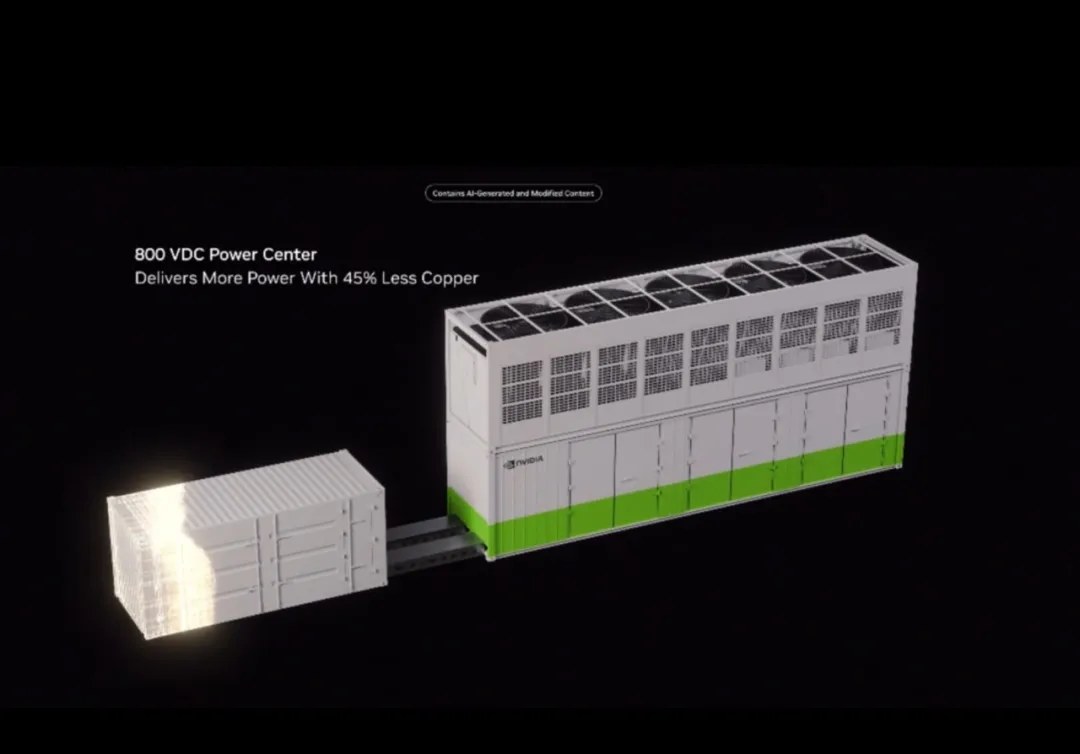
For power input, it adopts an 800V DC standard, reducing conversion stages and distribution losses and supporting higher-power compute racks.
02
Shorter On-Site Deployment, Faster Revenue
The most attractive point of DSX POD is that it compresses on-site deployment from six months to as fast as 14 days.
The AI factory model completes the integration and installation of compute, networking, cabling, rack-level power and liquid cooling systems at the manufacturing plant, thereby reducing the extensive planning, construction, specialized labor and logistics costs required by traditional on-site buildouts.
How much is the time saved worth?
At the event, Jensen Huang did the math: a 1 GW AI data center requires about US$50 billion in investment and, assuming it can generate US$40 billion in revenue per year, every quarter of delay in going live means US$10 billion in lost revenue.
That calculation rests on high revenue expectations, but it does hit the pain point of compute project construction: the money is spent, the equipment has arrived, yet the facility cannot start generating revenue.
In the traditional data center construction model, planning and layout, equipment arrival, installation and commissioning, network validation and system testing are all interlinked — if one step is not completed, the following work must wait. DSX POD moves assembly and validation forward to the factory and advances them in parallel with on-site infrastructure construction, completing what was originally serial work in parallel as much as possible and reducing waiting and rework after equipment arrives.
That is why NVIDIA places strong emphasis this time on "time to first production token" — the speed from equipment arrival and installation to "producing tokens."
The official announcement sets an on-site deployment target of as fast as 14 days; in his keynote, Jensen Huang estimated that the time from equipment arrival to production tokens could be shortened from four to five months to about one month.
The most direct beneficiaries are companies that build and operate AI factories.
For cloud providers and compute operators, this means less idle equipment, earlier order delivery and earlier revenue. For model companies building their own compute, it means earlier start of training and inference and faster updates and launches of large models. Enterprises and developers purchasing token services can also gain access to new capacity support sooner.
03
Designed by NVIDIA, Manufactured and Delivered by Partners
DSX POD adopts a partner-led delivery model.
NVIDIA provides a validated AI infrastructure design foundation and works with the ecosystem to prove that rack-level systems can be integrated, tested, transported and deployed as repeatable factory-prefabricated units.
NVIDIA provides the validated design foundation, while partners turn the solution into products that can be manufactured, transported and deployed. Compute systems are integrated by OEMs and ODMs, power and cooling facilities are adapted by specialized companies, modular solution providers manufacture enclosures and integrate subsystems, and on-site teams complete site preparation, installation and commissioning.
Participants include Dell, HPE, Lenovo, Foxconn, Quanta, as well as Schneider Electric, Vertiv and others. Dell has already announced a modular data center solution based on DSX POD, offering full lifecycle support from integration and testing to deployment and operations.
This model combines a unified design with local manufacturing, engineering and service capabilities. Customers purchase a complete solution, and delivery partners complete system integration and adapt it to local power and site conditions.
04
AI Factory Model: On-Site Integrators Hit Hardest
From the perspective of the global compute market, the impact of DSX POD on the industry may be long-lasting.
What was originally scattered equipment procurement and factory construction is becoming an AI factory delivery model that can be mass-manufactured and repeatedly deployed.
For enterprises with power and space, this lowers the difficulty and [cost] of building compute projects. For large operators, standard modules can be deployed in batches to support faster expansion. When choosing suppliers, customers will also pay more attention to how quickly production can start, how much usable compute can be provided, and who will ensure ongoing operations.
At the same time, "factory prefabrication + on-site interconnection" will squeeze the share of on-site integrators. Cabling, piping and testing are all "prefabricated" in the engineering process, leaving less work for on-site integration. Vendors that only sell standalone equipment and lack overall delivery capability will also be affected.
For NVIDIA, what it gains is influence over more parts of the industry chain. Once customers choose the Vera Rubin platform, networking, software, power and cooling are also organized around NVIDIA's architecture, so chip procurement drives procurement of the entire AI factory.